Erosion models#
Overview#
There are several options for how erosion can be defined in the Tc1D thermal models. Options for the erosion rate calculation include:
Constant rate with a step-function change at a specified time
Linear increase in erosion rate from a specified starting time
Below is a general description of how erosion is implemented in the code as well as details about how each option works.
General implementation#
The calculation of erosion rates in Tc1D is done in a function titled calculate_erosion_rate(). The function definition statement is below, to give you a sense of the values that can be passed to the function:
def calculate_erosion_rate(params, dt, t_total, current_time, x, vx_array, fault_depth, moho_depth):
    """Defines the way in which erosion should be applied."""
    ...
    return vx_array, vx_surf, vx_max, fault_depth
The function expects the following values to be passed:
params: The Tc1D model parameters dictionary. Relevant parameters include:params["ero_type"]: The type of erosion model to be used1= Constant erosion rate2= Constant rate with a step-function change at a specified time3= Exponential decay4= Thrust sheet emplacement/erosion5= Tectonic exhumation and erosion6= Linear rate change7= Extensional tectonics
params["ero_option1"],params["ero_option2"],...: Optional parameters depending on the selected erosion model
dt: The model time step in yearst_total: The total model run time in Myrcurrent_time: The current time in the modelx: The model spatial coordinates (depths)vx_array: The array of velocities across the model depth rangefault_depth: The depth of the fault in erosion model 7 (ignored for other erosion models)moho_depth: The current depth to the model Moho
The function returns the following values:
vx_array: The array of velocities across the model depth rangevx_surf: The velocity at the model surfacevx_max: The magnitude of the maximum velocity in the modelfault_depth: The depth of the fault in erosion model 7 (ignored for other erosion models)
Details about the implementation of the erosion model options can be found below.
Note: All plots below use invert_tt_plot = True and plot_depth_history = True.
Type 1: Constant erosion rate#
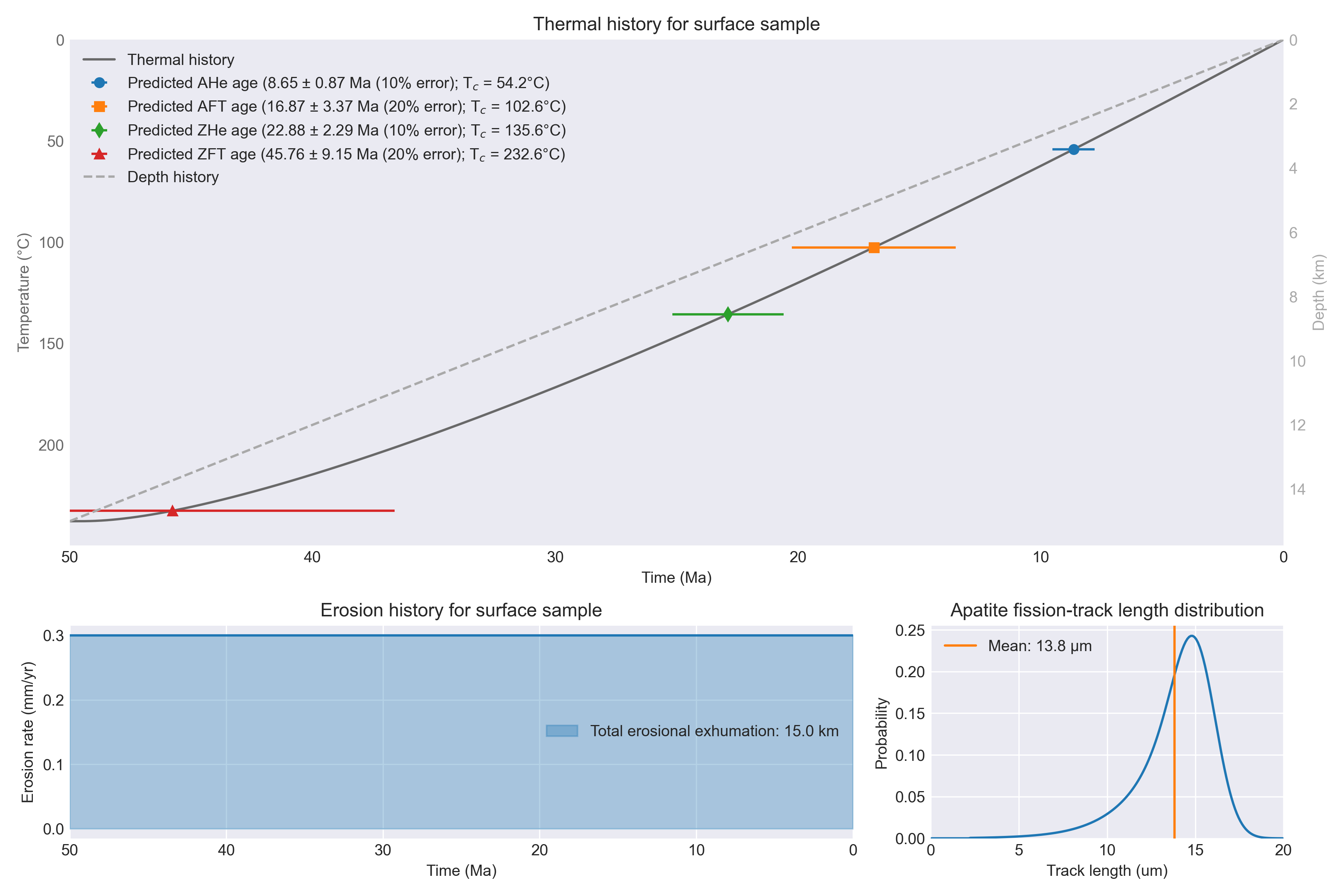
Example cooling history for the constant erosion rate erosion model.
The constant erosion rate case is used by defining params["ero_type"] = 1.
It is the simplest option in Tc1D and defined using one parameter:
params["ero_option1"]: the erosion magnitude \(m\) (in km).15.0was used in the plot above.
The calculated value for the erosion rate \(\dot{e}\) is simply the erosion magnitude divided by the simulation time (\(\dot{e} = m / t_{\mathrm{total}}\)).
Type 2: Constant erosion rate with step-function changes at one or more times#
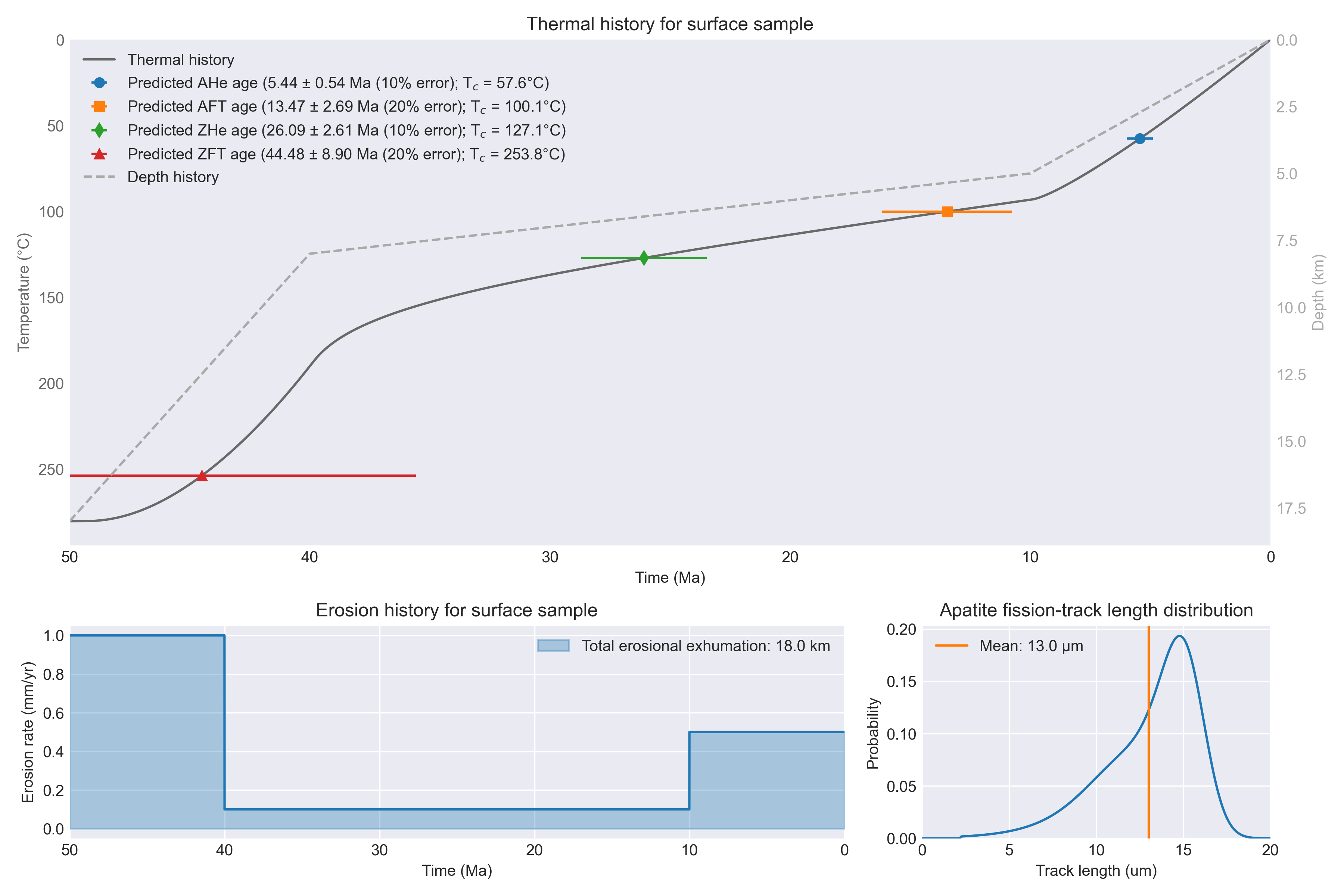
Example cooling history for the constant rates with step-function changes at specified times erosion model.
The constant rate(s) with step-function change(s) at specified time(s) case is used by defining params["ero_type"] = 2.
This model is designed to have up to two to three periods of constant erosion rates with one to two times at which the rate changes. The parameters used in this case are:
params["ero_option1"]: the exhumation magnitude \(m_{1}\) (in km) for the first phase.10.0was used in the plot above.params["ero_option2"]: the time \(t_{1}\) (model time in Myr) of the first transition in erosion rate.10.0was used in the plot above.params["ero_option3"]: the exhumation magnitude \(m_{2}\) (in km) for the second phase.3.0was used in the plot above.params["ero_option4"](optional): the time \(t_{2}\) (model time in Myr) of the second transition in erosion rate.40.0was used in the plot above.params["ero_option5"](optional): the exhumation magnitude \(m_{3}\) (in km) for the third phase.5.0was used in the plot above.
Note: If ero_option4 and ero_option5 are not specified, only one transition in rate will occur.
Similar to the constant erosion rate model, the erosion rates here are calculated as the erosion magnitudes divided a time duration. For two-stage models, the rates \(\dot{e}\) are:
For three-stage models, the rates \(\dot{e}\) are:
where \(t\) is the current model time.
Type 3: Exponential decay#

Example cooling history for the exponential decay erosion model.
The exponential decay case is used by defining params["ero_type"] = 3.
The exponential decay erosion model works by calculating a maximum erosion rate \(\dot{e}_{\mathrm{max}}\) based on the magnitude of exhumation \(m\), the characteristic time of exponential decay \(\uptau\), and the onset time for exhumation \(t_{\mathrm{start}}\). The user inputs \(m\) and \(\uptau\) (the time over which the erosion rate should decay exponentially to \(1/e\) times the original value), and optionally the value for \(t_{\mathrm{start}}\). The code determines the erosion rate that will result. The maximum erosion rate \(\dot{e}_{\mathrm{max}}\) is calculated as:
Two to three erosion model parameters are used for this case:
params["ero_option1"]: the exhumation magnitude (in km).15.0was used in the plot above.params["ero_option2"]: the characteristic time (in Myr).20.0was used in the plot above.params["ero_option3"]: (optional) the time at which exponential erosion begins \(t_{\mathrm{start}}\) (model time in Myr).0.0was used in the plot above.
The resulting erosion rate as a function of time \(\dot{e}(t)\) can be calculated as
where \(t\) is the current model time.
Type 4: Emplacement and erosional removal of a thrust sheet#
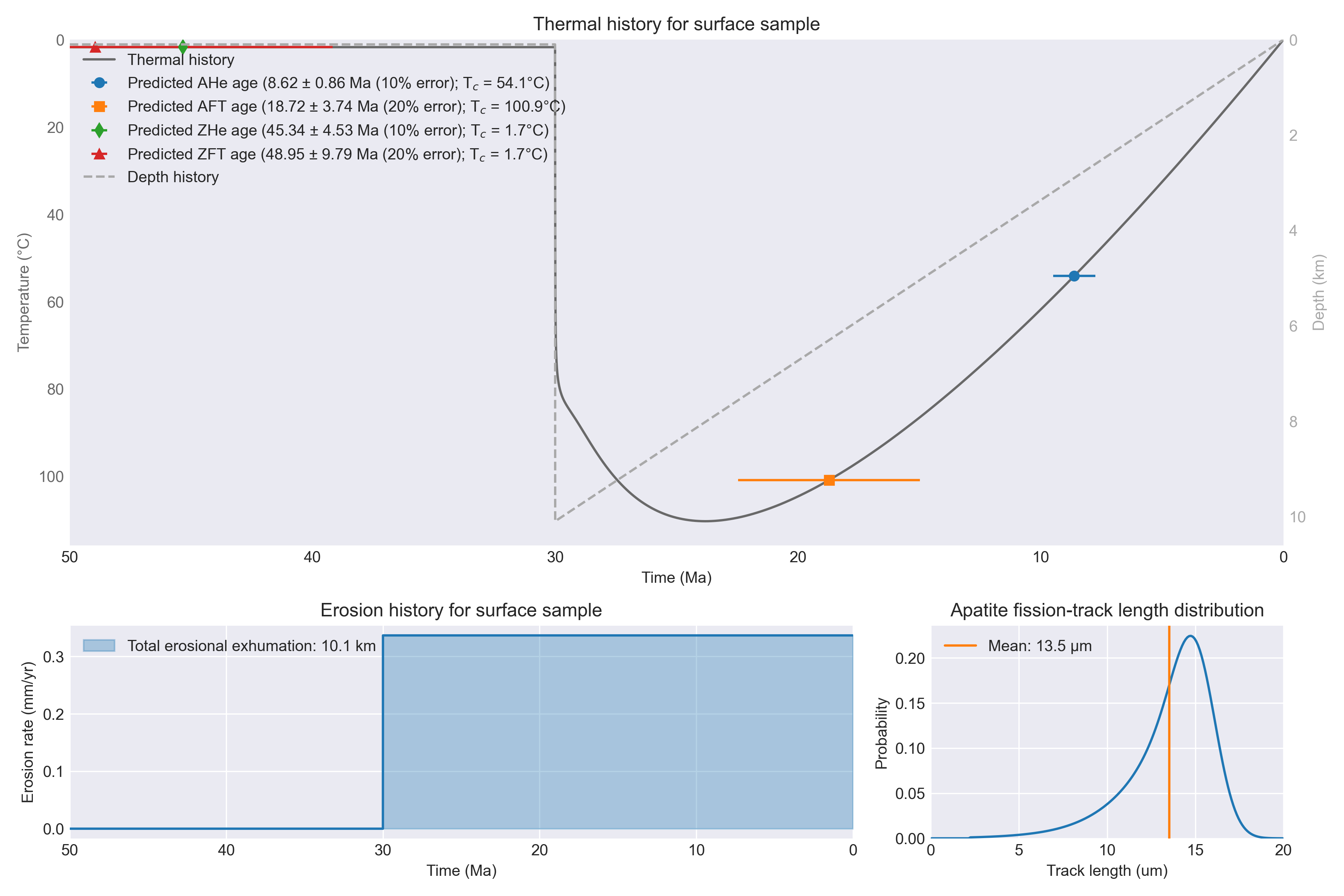
Example footwall cooling history for the emplacement and erosional removal of a thrust sheet model.
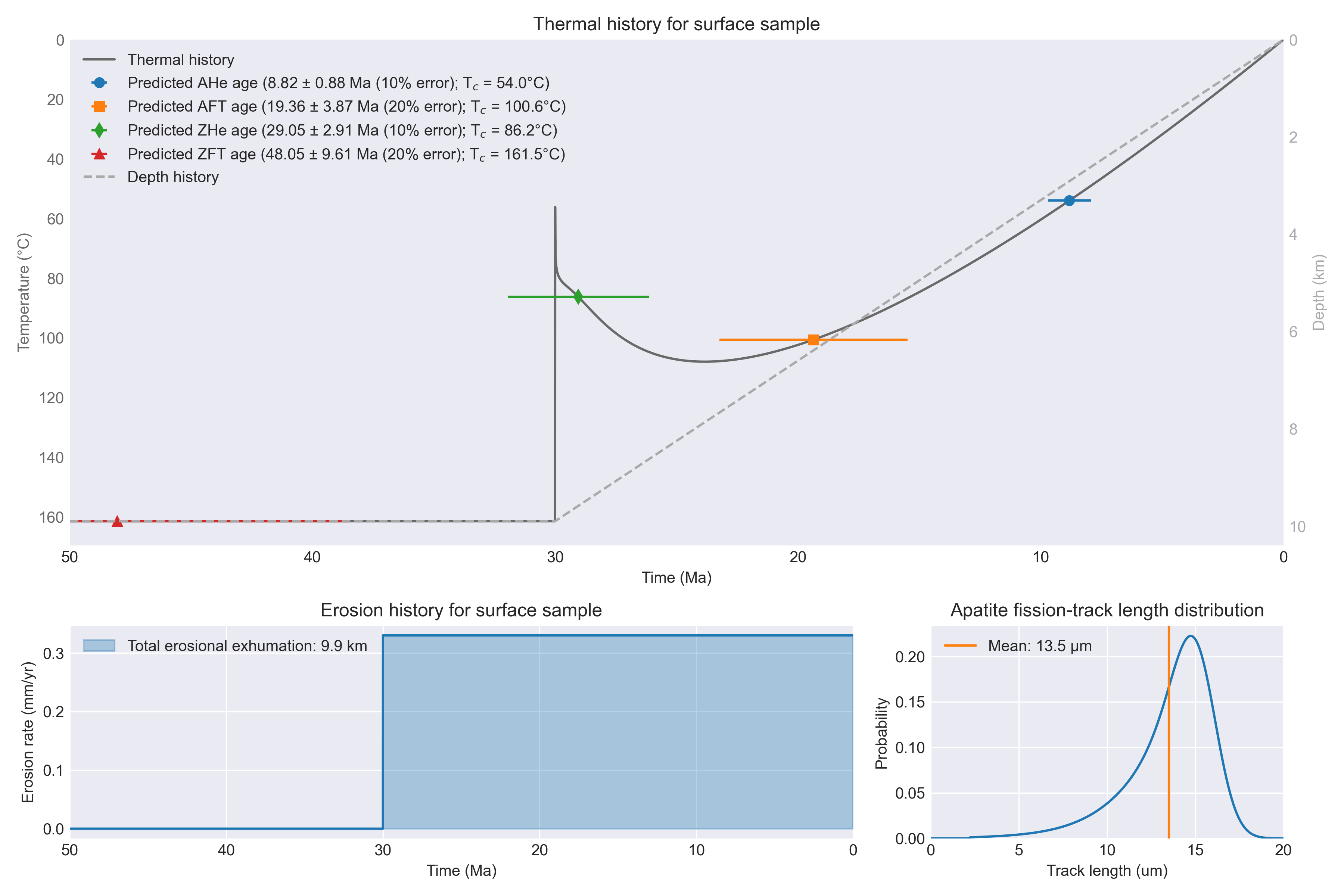
Example hanging wall cooling history for the emplacement and erosional removal of a thrust sheet model.
The emplacement and erosional removal of a thrust sheet case is used by defining params["ero_type"] = 4.
This model is based on the models of Oxburgh and Turcotte [1974] and Davy and Gillet [1986] (among others), where a thrust sheet of a finite thickness is instantaneously emplaced and cools as the thrust sheet and footwall are eroded. To identify whether the cooling history of the hanging wall or footwall should be recorded, it is possible to specify the position of the tracked particle above or below the thrust sheet. In addition, it is possible to specify when the thrust sheet is emplaced and when erosion begins in the model. The parameters used in this case are:
params["ero_option1"]: the thickness of the thrust sheet \(m_{1}\) (in km).10.0was used in both plots above.params["ero_option2"]: the additional magnitude of erosion below the thrust sheet \(m_{2}\) (in km).0.1was used in the upper plot above, and-0.1in the lower plot.params["ero_option3"]: (optional) the time at which the thrust sheet is emplaced \(t_{\mathrm{thrust}}\) (model time in Myr).20.0was used in both plots above.params["ero_option4"](optional): the time \(t_{\mathrm{ero}}\) (model time in Myr) at which the thrust sheet and footwall begin eroding.20.0was used in both plots above.
The resulting erosion rate as a function of time \(\dot{e}(t)\) can be calculated as
where \(t\) is the current model time.
Type 5: Tectonic exhumation and erosion#

Example cooling history for the tectonic exhumation and erosion model.
The tectonic exhumation and erosion case is used by defining params["ero_type"] = 5.
This model assumes an instantaneous amount of tectonic exhumation occurs at a given time and that additional exhumation can occur by erosion over a specified time period. The parameters used in this case are:
params["ero_option1"]: the depth of instantaneous tectonic exhumation \(m_{1}\) (in km).10.0was used in the plot above.params["ero_option2"]: the additional magnitude of erosion \(m_{2}\) (in km).5.0was used in the plot above.params["ero_option3"]: (optional) the time at which instantaneous tectonic exhumation occurs \(t_{\mathrm{exh}}\) (model time in Myr).20.0was used in the plot above.params["ero_option4"](optional): the time \(t_{\mathrm{ero}}\) (model time in Myr) at which erosional exhumation begins.20.0was used in the plot above.
The resulting erosion rate as a function of time \(\dot{e}(t)\) can be calculated as
where \(t\) is the current model time.
Type 6: Linear change in erosion rate from a specified time#
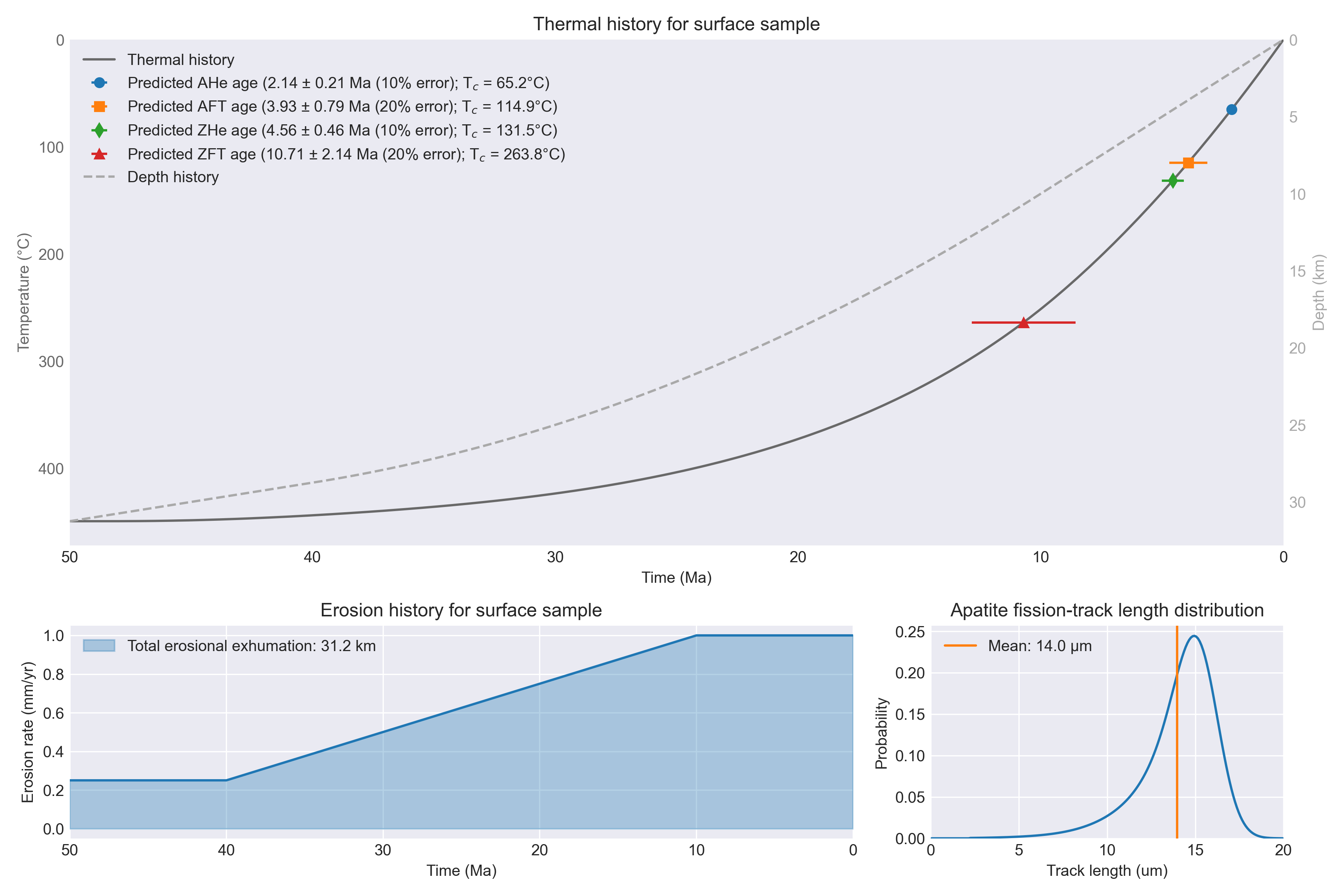
Example cooling history for the linear change in erosion rate from a specified time model.
The linear change in erosion rate case is used by defining params["ero_type"] = 6.
This model has a linear change in erosion rate from a starting rate to a final rate over a specified time window. The parameters used in this case are:
params["ero_option1"]: the erosion rate for the initial stage \(\dot{e}_{1}\) (in mm/yr).0.25was used in the plot above.params["ero_option2"]: the time at which the erosion rate begins changing linearly \(t_{1}\) (model time in Myr).10.0was used in the plot above.params["ero_option3"]: the erosion rate at the end of the simulation or for the final stage \(\dot{e}_{2}\) (in mm/yr).1.0was used in the plot above.params["ero_option4"](optional): the time \(t_{2}\) (model time in Myr) at which the final erosion rate is reached.40.0was used in the plot above.
The value for \(t_{2}\) is assigned the total model run time \(t_{\mathrm{total}}\) if no value is given for params["ero_option4"].
The erosion rates for the linear change phase can thus be calculated as
where \(t\) is the current model time.
Type 7: Extensional tectonics#
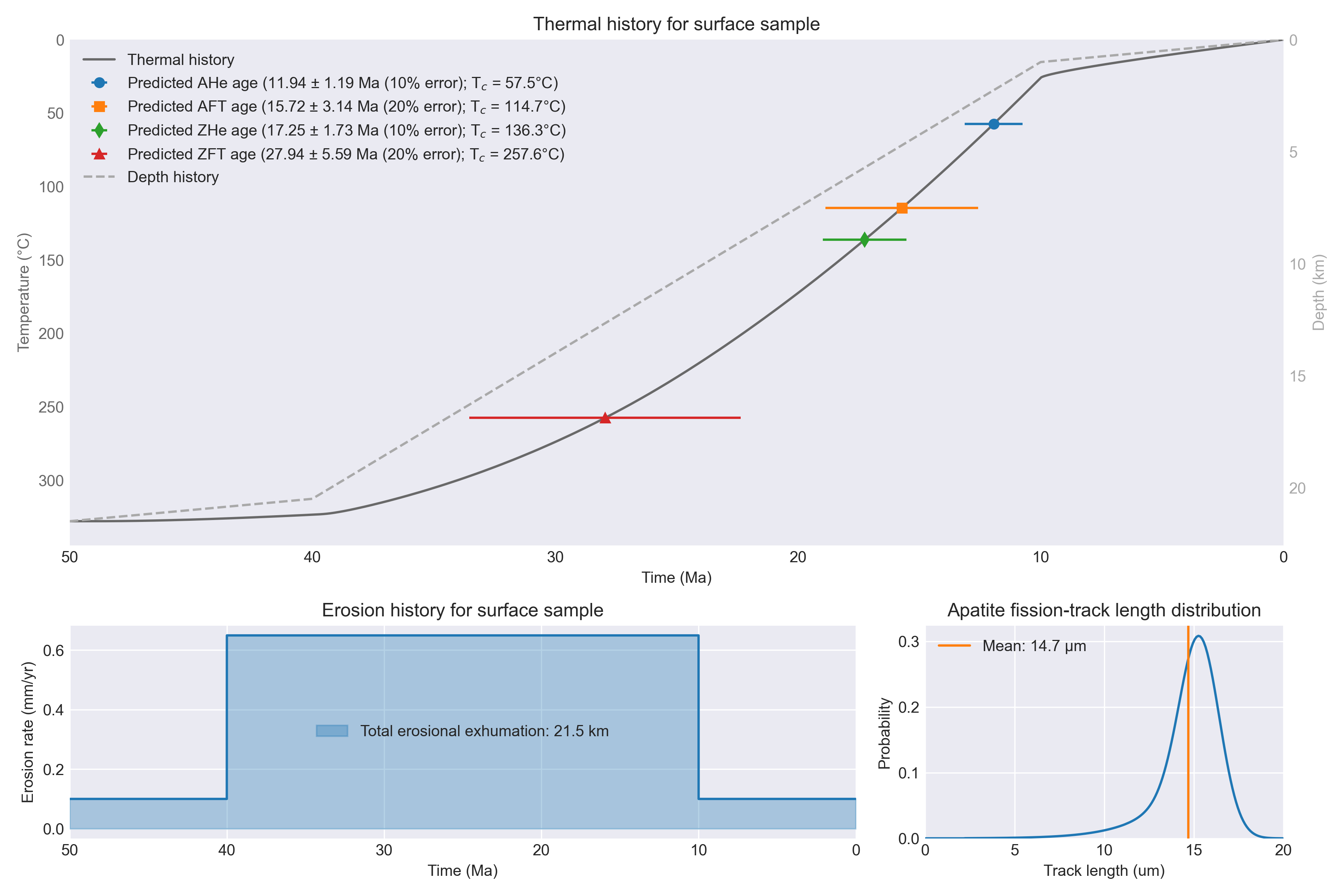
Example cooling history for the extensional tectonics model.
The extensional tectonics case is used by defining params["ero_type"] = 7.
The extensional tectonics model is slightly more complex than the others as the velocity varies as a function of depth. The main model features are defined using four model parameters, as shown in the figure below.

Extensional tectonics model geometry and parameters.
As shown above, the model requires definition of the fault slip rate, slip partitioning, and geometry. The fault depth will change with time following the velocity of the footwall. This basically assumes that the reference frame for a sample reaching the surface is on the footwall vertically above the sample. In other words, although there are no horizontal velocities in the model, all horizontal motion is assumed to occur in the hanging wall.
In addition to the geometric and fault parameters above, it is possible to define time periods with a constant erosion rate before and after the extensional fault becomes active. This allows exhumation before and after fault activity.
The complete list of parameters used for this case are:
params["ero_option1"]: the fault slip rate \(v\) (in mm/yr).1.5was used in the plot above.params["ero_option2"]: the partitioning factor between hanging wall and footwall motion \(\lambda\). A value of \(\lambda = 0\) corresponds to a fixed footwall (only motion in hanging wall), and a value of \(\lambda = 1.0\) corresponds to a fixed hanging wall (only motion in footwall).0.5was used in the plot above.params["ero_option3"]: the dip angle \(\gamma\) of the fault (in degrees).60.0was used in the plot above.params["ero_option4"]: the fault depth at the start of the simulation \(b\) (should be a positive number in km).10.0was used in the plot above.params["ero_option5"](optional): the erosion rate for the initial stage \(\dot{e}_{1}\) (in mm/yr).0.1was used in the plot above.params["ero_option6"](optional): the time at which the extensional fault model becomes active \(t_{1}\) (model time in Myr).10.0was used in the plot above.params["ero_option7"](optional): the erosion rate for the final stage \(\dot{e}_{2}\) (in mm/yr) after the extensional fault model deactivates.0.1was used in the plot above.params["ero_option8"](optional): the time \(t_{2}\) (model time in Myr) at which the final erosion stage begins.40.0was used in the plot above.
Thus, the erosion rates for the different model stages are:
where \(t\) is the current model time.
Elevation-dependent erosion#
Elevation-dependent erosion has not yet been implemented.
Notes#
It would be good to ensure that in the step model the initial erosion phase doesn’t result in erosion of the entire difference in Moho height. There should at least be a warning printed to the screen in these cases.
References#
E. R. Oxburgh and D. L. Turcotte. Thermal gradients and regional metamorphism in overthrust terrains with special reference to the Eastern Alps. Schweizerische mineralogische und petrographische Mitteilungen, 54:641–662, 1974. doi:10.5169/seals-42213.
P. Davy and P. Gillet. The stacking of thrust slices in collision zones and its thermal consequences. Tectonics, 5(6):913–929, 1986. doi:10.1029/TC005i006p00913.